Thread vs. Zigbee: What Actually Matters Before You Buy
Thread, Zigbee, and Matter are easy to confuse. Learn what each one needs and the compatibility checks to make before buying a smart-home device.
A Thread label, a Zigbee label, and a Matter badge can all appear on products that look almost identical. They do not mean the same thing.
For a buyer, the useful question is not which protocol wins on paper. It is whether a new device will join the home you have without adding an unexpected hub, leaving you with a second app, or limiting the controls you expect to use.
This guide separates the three terms, then turns them into a pre-checkout list.
Thread vs. Zigbee: the basic difference
Thread and Zigbee are low-power wireless mesh technologies. They are designed for devices that need modest bandwidth and long battery life, such as sensors, bulbs, switches, locks, and shades. A mesh lets eligible powered devices help pass messages across the network, rather than making every device depend on one direct connection to a Wi-Fi router.
The practical difference is how each network fits into the wider smart-home system.
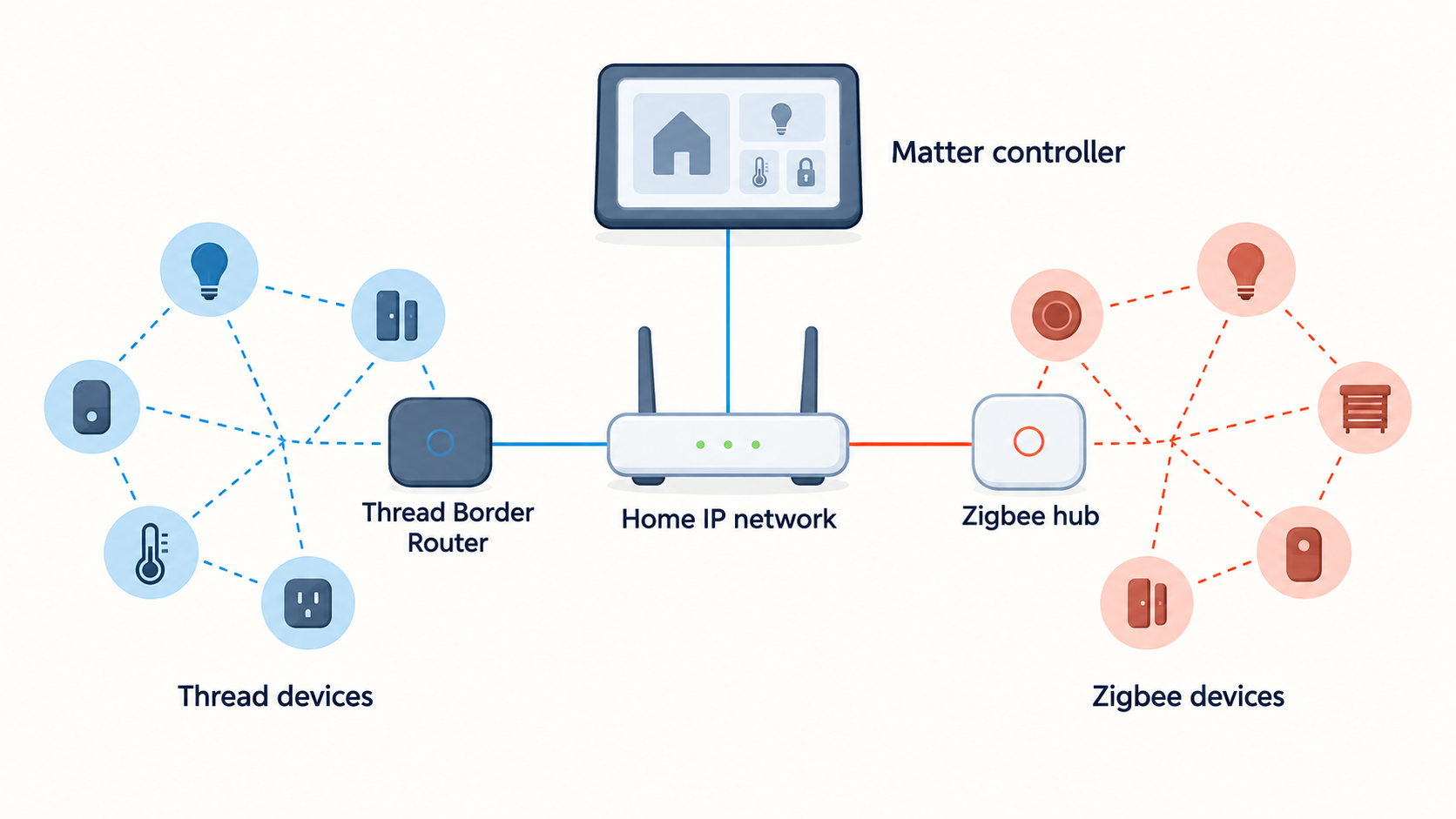
Thread is an IP-based mesh network. Thread devices use a Thread Border Router to connect their mesh to the home’s IP network. That border-router role may be built into compatible smart-home hardware, but it is not present in every speaker, display, router, or hub.
Zigbee is a mature, full-stack smart-home standard with a large installed base, particularly in lighting and sensor ecosystems. A Zigbee device generally joins a compatible Zigbee hub, bridge, or coordinator. That device manages the Zigbee network and commonly provides the connection to an app or wider platform.
Neither option is automatically better. The useful choice depends on the controller, bridge, and devices you plan to use together.
Matter is different from both
Matter is not a radio technology. It is a smart-home application standard that lets supported devices, controllers, and platforms communicate over IP-based networks. Matter can use Wi-Fi, Ethernet, or Thread for its network connection, with Bluetooth Low Energy commonly used during setup.
That distinction matters when reading product pages. A Matter-over-Thread device uses Thread as its low-power network. A Matter-over-Wi-Fi device does not. A Zigbee device does not become a Thread device because it can be reached through Matter.
Matter can work with older network types through a Matter bridge. A manufacturer may use a bridge to expose selected Zigbee devices to a Matter ecosystem. The bridge, its firmware, and the supported device categories determine what actually works. Check the manufacturer’s compatibility documentation instead of assuming every feature will transfer.
What each setup requires
| Technology | What it is | What the device usually needs | What to check before buying |
|---|---|---|---|
| Thread | Low-power, IP-based mesh network | A compatible Thread Border Router and a controller that supports the device | Confirm the exact controller, border router, device category, and current platform support |
| Zigbee | Low-power smart-home mesh standard | A compatible Zigbee hub, bridge, or coordinator | Confirm that the hub supports the product and the features you need |
| Matter | Application standard for supported smart-home devices | A Matter controller; the underlying network may be Wi-Fi, Ethernet, or Thread | Check the transport, device category, controller support, and whether support is native or bridge-based |
When Thread makes sense
Thread is a strong fit when you are intentionally building a Matter-based system and already have compatible infrastructure. It is particularly useful for battery-powered or low-power devices that benefit from a mesh network without each device joining Wi-Fi directly.
Before you buy, identify the exact Thread Border Router in your home. Then verify that your preferred smart-home platform can control the product category you are considering. A controller can support Matter without also functioning as a Thread Border Router, and a Thread Border Router does not by itself guarantee support for every Matter device category.
Do not buy Thread only because it sounds newer. Buy it when the device, controller, and border router form a documented combination you actually want to use.
When Zigbee makes sense
Zigbee is often the sensible choice when the products you want belong to an established Zigbee ecosystem. It remains common in smart lighting and sensor setups because a compatible hub can provide dependable local coordination and a broad range of accessories.
If your current Zigbee bulbs, sensors, or switches work well, replacing them solely to move to Thread is rarely a compelling upgrade. A compatible Matter bridge may allow a Zigbee ecosystem to participate alongside newer Matter products while preserving the devices you already own.
The important caveat is that bridge support varies. Do not assume that every option available in a manufacturer’s own app will appear in another platform, or that a bridge exposes every advanced setting to Matter.
What to check before checkout
Use this list for any Thread, Zigbee, or Matter product:
- Identify the network the product actually uses. Look for Thread, Zigbee, Wi-Fi, or Ethernet, not just a Matter badge.
- Identify the device that will connect it to your home. For Thread, this is a compatible Thread Border Router. For Zigbee, it is a compatible hub, bridge, or coordinator.
- Check the controller you will use every day. Confirm that your preferred platform supports this device category and the controls that matter to you.
- Check whether compatibility is native or bridged. A bridge can be useful, but it may expose a smaller feature set than the manufacturer’s own ecosystem.
- Check exact model and firmware support. Product families often contain variants with different radios or software support.
- Keep existing devices in the decision. The best new device may be one that extends a reliable setup instead of starting a parallel ecosystem.
- Plan for household use. Make sure the device can still be controlled in a way that makes sense to everyone at home, including when an app, account, or internet connection is unavailable.
For more practical starting points, explore Better Things Daily’s smart-home guides, including our guides to smart-home devices for beginners and smart-home hubs.
Common compatibility mistakes
The most common mistake is treating Matter as a guarantee that every smart-home device will work together in every way. Matter improves interoperability for supported devices, but it does not erase the practical details: which transport a device uses, whether a bridge is involved, what the controller supports, and whether the feature you care about is included.
Another mistake is buying a Thread device without first confirming a compatible Thread Border Router. A home can have a Matter controller yet lack the hardware needed for a Thread device to reach the home IP network.
Finally, do not dismiss Zigbee as obsolete. A good Zigbee hub and a well-supported product range can be a better buying decision than a newer standard with a less suitable device selection.
The practical choice
Choose the product that solves the task, then validate the path between that product and your smart-home platform.
For a new Matter-focused setup, Thread is often worth considering when a compatible border router and controller are already in place. For an established lighting or sensor ecosystem, Zigbee can remain the better fit. And when a Zigbee bridge offers Matter support, it may be the easiest way to combine old and new devices without replacing hardware that still serves you well.
A protocol should be a compatibility check, not the whole buying decision.
Frequently asked questions
Is Thread better than Zigbee?
Not universally. Thread can be a natural fit for a Matter-based smart home with a compatible border router. Zigbee can be the stronger choice when its hub and product ecosystem better match the devices you want.
Do Thread devices need a hub?
They need a compatible Thread Border Router to connect the Thread mesh to the home IP network. The border-router capability may be built into another compatible device, rather than sold as a dedicated hub.
Do Zigbee devices work with Matter?
Some can participate through a manufacturer’s Matter bridge. The bridge must support the specific product and feature set; a Zigbee device does not become a native Thread or Matter device.
This article may contain affiliate links. If you purchase through them, Findory may earn a commission at no extra cost to you. Read our disclosure.
